Dock guide
What drives the cost of a boat dock on a west Georgia lake
We don't post dock prices, because a number given without seeing the lot would mislead you. What moves the cost is the lake's rules, the water and shoreline at your lot, the materials, and whether an old dock must be brought up to current standards. Send your lake, lot and wishes through the quote form and we will tell you plainly what the job involves.
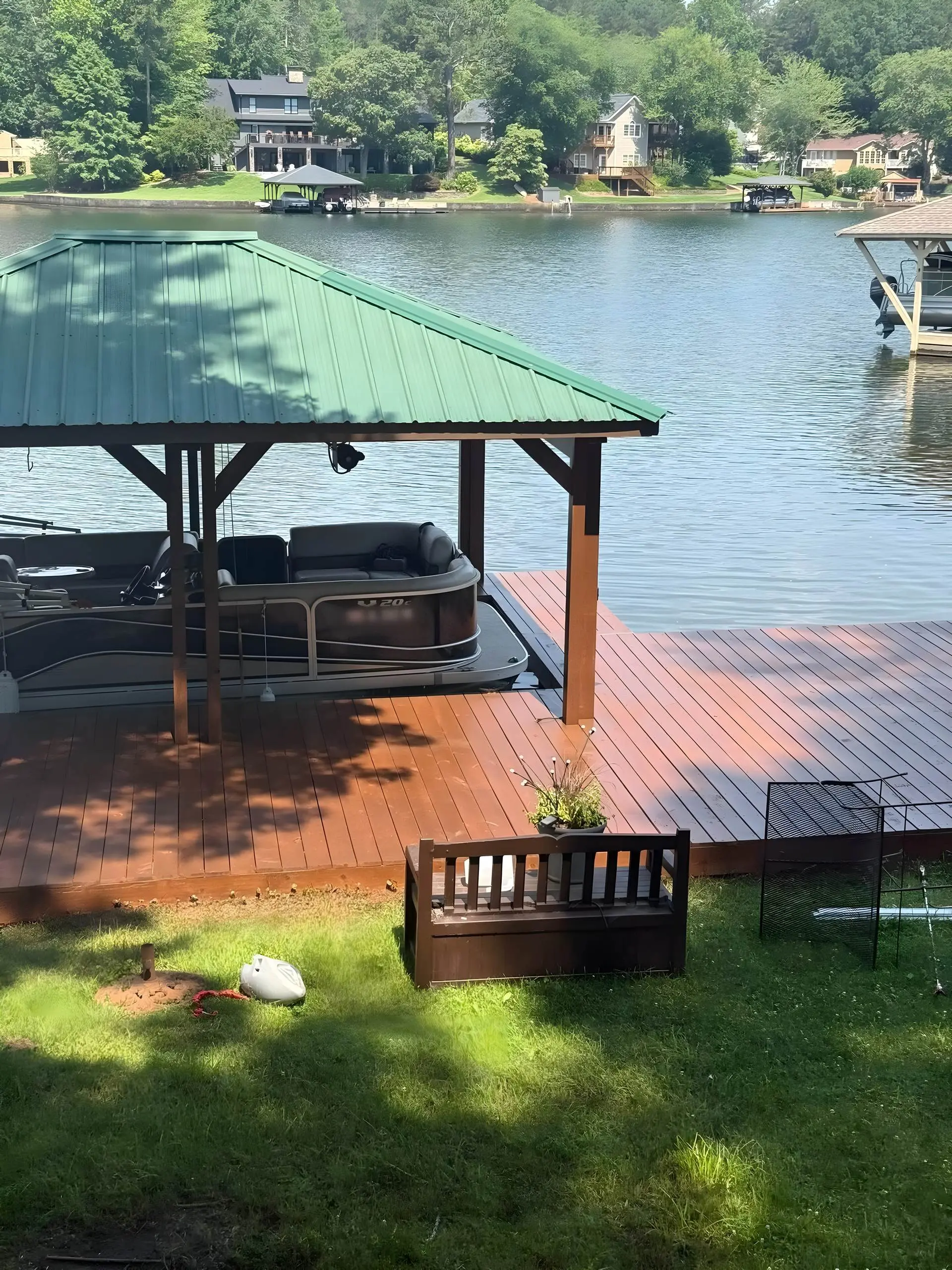
Why there is no price here
A dock is not a product with a list price. Two lots on the same cove can need different docks because the water depth, the width of the cove and the shape of the shoreline differ, and the rules differ more from lake to lake. A figure on a web page would be wrong for most readers. Below is what moves the cost, roughly in the order a job runs into it. When you know your lake and what you want, send the details through the quote form.
The lake sets the rules before the design starts
West Point Lake is run by the U.S. Army Corps of Engineers. Lake Carroll is run by the City of Carrollton. Fairfield Plantation is private, and its Property Compliance Committee decides. Each has its own size limits and paperwork, so a dock that is fine on one lake can be the wrong size or not allowed on the next. Our dock permit guide covers who approves what.
Rules that add work on West Point Lake
The Corps' Shoreline Management Plan is detailed. These rules change what gets built:
- Engineered plans. "All floating facility plans are subject to approval by West Point Lake staff and must be certified by a licensed professional engineer." Staff approval says the dimensions and materials meet lake standards, not that the design meets engineering standards.
- A size range, and a lake that can shrink it. A private floating dock is between 144 and 1,024 square feet. "Less than maximum allowable sizes may be mandated by such site conditions as the width of the cove or channel and the density of development." At the maximum size, nothing like a boat lift can be added to the outside. See our boat lift guide.
- Floating, hinged walkways. Walkways "must be hinged and floating sections," 4 to 6 feet wide. Fixed sections "are no longer authorized due to safety concerns related to fluctuating water levels." A walkway section 4 feet or more above land or water needs rigid handrails on each side.
- Flotation with a spec. It must not become waterlogged, must resist animals, and must not sink or contaminate the water if punctured. Metal-covered and injected-drum flotation is not allowed.
- A materials list. Wood must be pressure-treated, cedar, redwood, cypress or marine-grade, and creosote-, arsenic- and penta-treated wood is not acceptable. Hardware is galvanized or stainless steel.
- Electrical. New dock power "must be certified by a state licensed electrician immediately upon installation," and again at permit renewal and change of ownership. The plan's exhibit calls for buried cable at least 24 inches deep, ground fault protection and wiring approved for wet locations and run in conduit. See our dock lighting guide.
Rules at Fairfield Plantation and Lake Carroll
At Fairfield Plantation, the Rules and Regulations (Section 5.2.2) say that on Lake Tara an approved seawall is built before or at the same time as the dock. The dock sits at least 10 feet from each side property line and reaches no more than 20 feet into the lake from the face of the seawall, or from the natural shoreline on a Lake Ashley or Lake Scarlett lot with no existing seawall. Where the lake is narrower than 240 feet, or the lot is in a cove, the committee "reserves the right to place restrictions on the size and/or location." Posts are at least 4 by 6 inches and driven at least a foot and a half into the lake bed, and PVC and metal posts are not permitted. A covered dock has a roof no higher than 14 feet above normal pool and open sides.
On Lake Carroll, which the city runs, Section 70-58 requires a permit from the building official, allows one structure per parcel and per 100 feet of shoreline, and caps docks and piers at 20 feet from the shoreline. Boathouses "must be dug back into the lake front owner's property so as not to extend out into the water." The two 20 foot limits are not the same rule: Fairfield measures from the seawall face where there is one, and Lake Carroll from the shoreline. See our pages for Fairfield Plantation and Lake Carroll.
What your shoreline and water do
- Depth. West Point requires at least 4 feet of water under the lake side of the dock at lake elevation 635 feet. The plan says this "is intended to allow for daily and seasonal water fluctuations." A shallow cove can rule out a spot.
- Neighbors and the cove. On West Point Lake, a new dock sits at least 50 feet from other permitted docks, and the center third of a cove stays open for boats. Fairfield and Lake Carroll set their own spacing, covered above.
- Whether the lot qualifies. West Point allows one dock per separately surveyed, platted and recorded lot, with at least 20 feet of shared boundary with public land. Docks go only in Limited Development shoreline, about a quarter of the lake's shoreline, so the first question is for the park ranger.
- The seawall behind it. A failing wall becomes part of the job. See our guides on seawall repair and seawall versus riprap.
- Fixed or floating. Where a choice exists, it changes the structure. Our floating versus fixed guide compares them.
Materials
The Forest Products Laboratory's Wood Handbook sorts treated wood into use categories by exposure. Decking sits in the category for "General above-ground use, fully exposed to weather." Freshwater piles fall under the category for "Ground contact or fresh water, structurally critical." In plain terms, the posts and piles in a lake need a tougher treatment than the boards on top. The Handbook's chapter on decay adds that molds, decay and stains caused by fungi "depend heavily on temperature and moisture conditions."
Composite decking is allowed at West Point and Fairfield. A Forest Service chapter on wood-plastic composites says that kind of decking is "more expensive than pressure-treated wood," and that its actual lifetime "is currently being debated." Our composite versus pressure-treated guide goes further.
Rebuilds and old docks
An old dock often cannot be swapped like for like. The West Point plan says: "All permitted and/or licensed facilities must conform to the current standards listed herein upon change of ownership, upon the death of the permit holder and his/her spouse, or when major repairs are required." Replacement flotation must meet current rules, handrails must be installed as required, and electrical systems must meet the current National Electrical Code. For docks grandfathered outside Limited Development shoreline it is stricter: at a sale, a major repair, or the death of the permit holder and spouse, the plan requires the dock to be removed, not rebuilt. Docks protected by federal law since 1986 may stay where they are if kept safe and usable. Moving a grandfathered dock ends its protected status.
Taking the old dock out costs work too. The EPA says not to burn preservative-treated wood in a residential setting, "to avoid possible inhalation of toxic chemicals in the smoke and ash," so old timber has to be hauled away, not burned. Fairfield also requires that debris be kept from washing into the lake. See our dock repair page.
What to have ready for a quote
- The lake and community name.
- Your deed and the recorded plat showing the lot lines and shoreline contact.
- Any existing permit paperwork, and photos of any existing dock.
- Your boat's length and type, plus any lift.
- What you want: roof, power, lights, storage.
- Photos of the shoreline at low and high water, and any depth measurements.
- The seawall's condition, and your association's approval status if you have one.
Then tell Ambrose through the quote form.
Questions people ask
How much does a boat dock cost in Georgia?
We don't quote a figure without seeing the lot. The cost depends on the lake's rules, the size the lake allows, the water depth, the materials, the power and whether an old dock has to be removed.
How much does a floating dock cost?
The same drivers apply. On West Point Lake, the plan covers private floating docks and no longer authorizes fixed walkway sections. Size, flotation, materials, power and engineered plans set the cost.
Do I need a permit for a dock?
Every rule set we read requires approval: the Corps at West Point, the building official at Lake Carroll, and the Property Compliance Committee at Fairfield Plantation. The West Point plan states no processing time.
Sources
- U.S. Army Corps of Engineers, Mobile District, West Point Lake Shoreline Management Plan (cover date September 9, 2024): Section 8 (shoreline allocations), Section 10 (private individual floating facilities), Section 14a (electrical service), Section 15 (grandfathered facilities) and Exhibits V, VII and XIV.
- Fairfield Plantation Property Owners Association, Rules and Regulations for Property Owners (revised February 16, 2026): Section 5.2.2.
- City of Carrollton, Code of Ordinances Section 70-58, Lake Carroll.
- USDA Forest Products Laboratory, Wood Handbook, FPL-GTR-282 (2021), Chapter 15, Table 15-6; and Chapter 14.
- Caulfield and Clemons, Wood Thermoplastic Composites (USDA Forest Products Laboratory, 2010).
- U.S. Environmental Protection Agency, Chromated Arsenicals (CCA).
Rules change and each lake has its own. Confirm current requirements with the permit office before you build.