Dock guide
Floating vs fixed docks on west Georgia lakes
On West Point Lake the choice is made for you: the Corps plan covers private floating facilities, and it says fixed walkway sections are no longer authorized. On other lakes, water level swing and the lake bottom decide it. A floating dock rides the water up and down. A fixed dock on posts stays put, which is steady underfoot but can end up too high or too low when the lake moves.
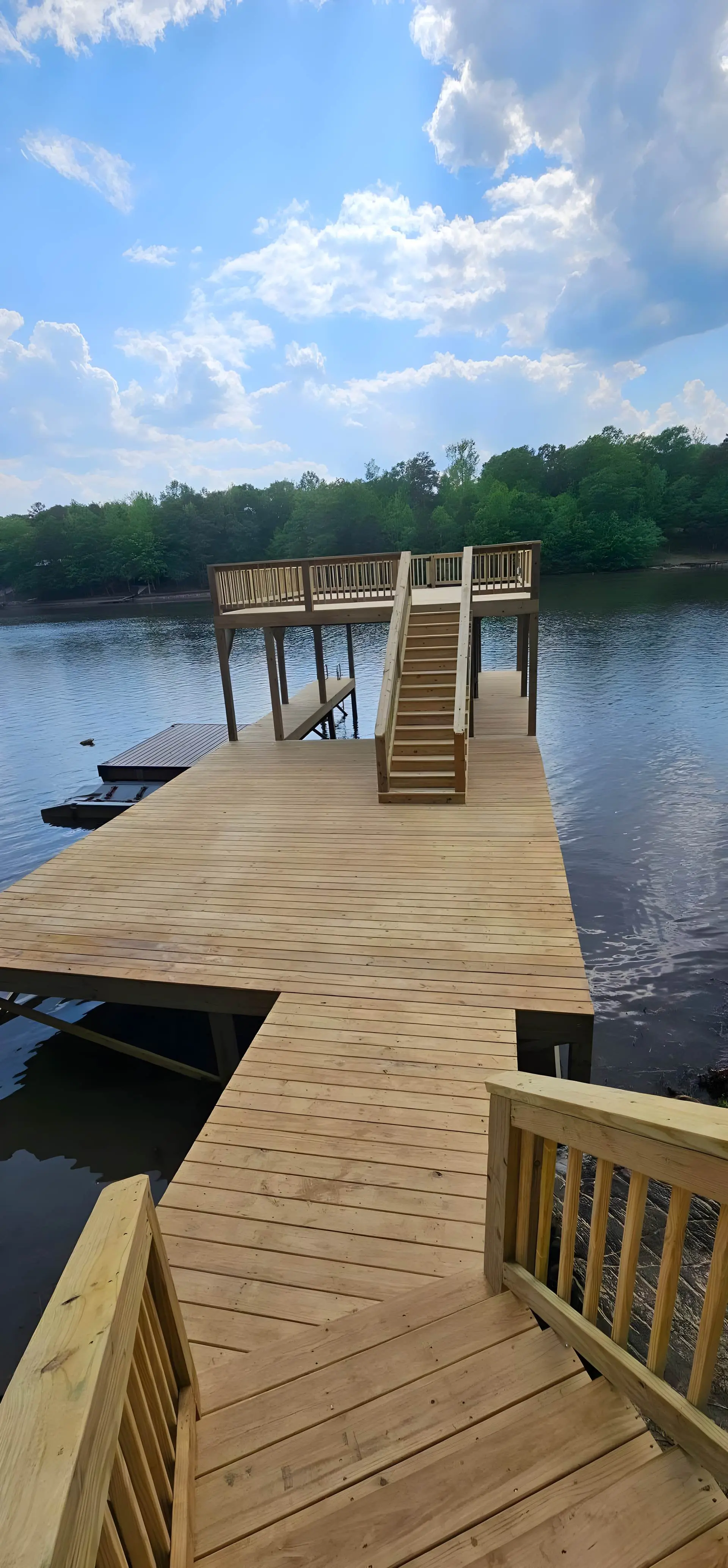
Which type is allowed where
Check the rules before you look at designs. On the lakes around here, the owner of the water often decides what kind of dock you can build.
West Point Lake
The U.S. Army Corps of Engineers owns the whole shoreline of West Point Lake. Its Shoreline Management Plan was updated for the first time since 1993 and took effect October 1, 2025, according to the Corps' news release. The plan's rules for private docks are written for "private individual floating facilities." The walkway from shore to the dock must be "hinged and floating sections," and the plan says "fixed sections are no longer authorized due to safety concerns related to fluctuating water levels."
Existing permits for fixed-section walkways are not wiped out. The plan lets them renew or transfer until major repairs are needed. At that point the dock has to be brought up to current rules, so a big rot repair on an old fixed walkway is the moment it becomes a floating one. A few more West Point rules shape the design:
- Floating plans must be certified by a licensed professional engineer. Staff approval of the plans, the plan says, does not mean they meet engineering standards.
- The walkway plus the dock, including a moored boat, can run no more than 100 feet out from the 635 foot elevation line. The dock itself can be 144 to 1,024 square feet.
- Anchoring is by cables to posts onshore, or by posts set at least 3 feet into the lake bottom with tops at least 7 feet above the 635 foot line. Concrete anchor pads and fixed sections alone do not count as enough.
The full local picture, including who is eligible for a permit, is on our West Point Lake dock page.
Lake Carroll
Lake Carroll is a city reservoir, and the Carrollton code (Section 70-58) covers private docks. The shoreline cannot be altered without written consent and a permit from the building official, and "no dock, piers or related structures may extend further than 20 feet from the shoreline into the lake." The sections we reviewed limit how far a structure reaches, not whether it floats. Ask the building official before you commit to either type. Our Lake Carroll page has the rest of the code.
Fairfield Plantation
Fairfield's Rules and Regulations make a dock a revocable privilege, reviewed case by case. Nothing may extend into the lake more than 20 feet from the face of the seawall, or from the natural shoreline on a Lake Ashley or Lake Scarlett lot with no existing seawall. The construction rules describe vertical posts, piers or columns at least 4 by 6 inches, driven at least 1.5 feet into the natural ground of the lake bed, and they ban PVC or metal posts. Floating docks are not described in the sections we read, so ask the Property Compliance Committee before you design one. More on the neighborhood is on our Fairfield Plantation page.
Other lakes and HOA lakes
Private lakes and neighborhood lakes set their own rules, and many require written approval before any dock goes in. Get the rules and the approval first, then choose the type.
Water level: the biggest difference
Reservoirs rise and fall. The West Point plan says as much: it asks for 4 feet of water under the lakeside of a floating dock at the 635 foot level "to allow for daily and seasonal water fluctuations," and it makes the permit holder responsible for protecting the facility "during low- and high-water periods."
EZ Dock, a floating-dock manufacturer, makes the tradeoff plainly in its guide to residential dock types. Floating sections keep "a consistent height regardless of how high or low the water level is," while a fixed dock "doesn't adjust as seasonal water levels rise and fall" because the installer sets the height. Its dock safety guide adds the other side: fixed docks "offer stability under heavy foot traffic and large vessels, but they can sit too high or too low depending on water conditions."
In practice, a fixed deck set for summer level can leave a long step down to the boat when the lake is low. Set for low water, it can sit in the water in a flood. A floating dock avoids that, but its walkway to shore still has to cope with the angle, which is why the West Point plan requires a hinged walkway.
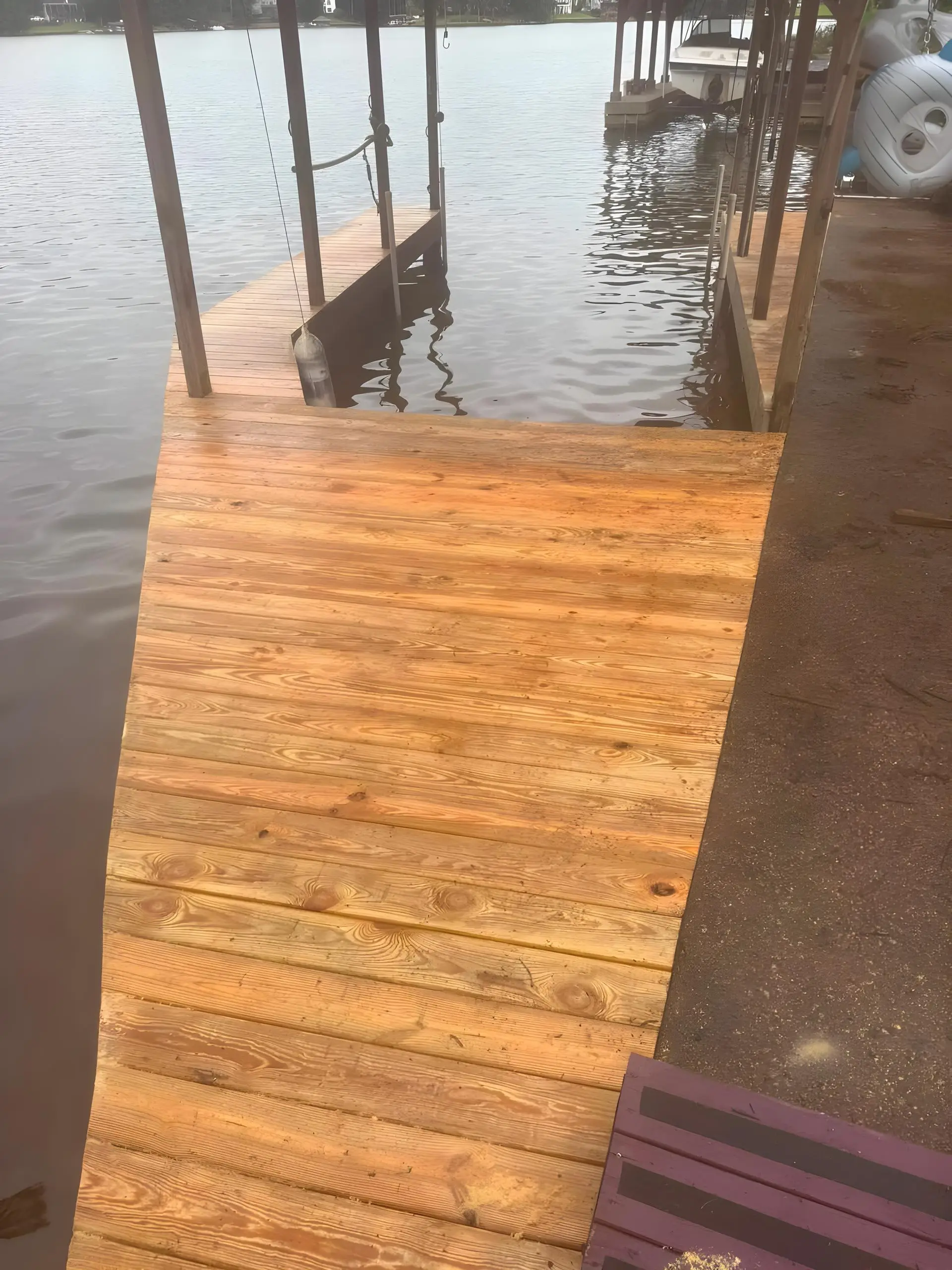
Depth and lake bottom
A fixed dock is only as good as what holds the posts. EZ Dock describes piling docks as wood or steel pilings "driven deep into the lakebed" and crib docks as rock-filled frames anchored to the bottom, and notes that fixed docks usually need professional equipment and lakebed work. Fairfield's rule of a 1.5 foot minimum embed "or to a greater depth if necessary to provide required lateral support" shows the same thing: the bottom decides how deep the posts go.
A floating dock needs enough water under it at all times. West Point sets a 4 foot minimum at the 635 foot level. A flat, shallow cove that goes nearly dry in a drawdown is a poor fit for a floating dock unless it can rest on the bottom without damage, and that is a question for the plan reviewer and the engineer, not a rule of thumb. Soft mud and rock both complicate post setting and make anchor posts harder to place, so a site visit matters more than any brochure.
Waves and wakes
Floating docks move, and that is by design. EZ Dock's FAQ explains its flexible couplers this way: when wave action is strong, the couplers "absorb the shock rather than the dock sections," and if it becomes too severe, they are meant to fail before the sections do. It contrasts this with traditional floating docks, which attach flotation to a rigid frame with bolts and screws and so have no give.
Whatever the type, the West Point plan puts the burden on the owner: the facility must be "engineered and maintained to remain safe when exposed to environmental conditions (such as wind, wave action, rain, and temperature extremes) and fluctuating lake levels." A dock beside a busy channel or a long fetch deserves a stronger anchoring plan than one at the back of a quiet cove.
Flotation types
"Floating" covers several kinds of float, and West Point is specific about which are acceptable for new or replacement work:
- Foam-bead billets with a minimum density of 1.2 pounds per cubic foot are authorized. A 1.0 pound product is allowed only if encased in a protective coating the manufacturer warrants for at least 8 years against cracking, peeling and UV breakdown.
- Waterlogging limit: new flotation must not take on more than 1.5 percent water by volume under the ASTM test, must resist animal damage, and must not sink or contaminate the water if punctured.
- Not allowed: metal-covered flotation and injected-drum flotation.
Outside the plan, some makers sell modular polyethylene sections that float on their own. EZ Dock says its sections are linear low-density polyethylene and need no staining or board repair. The wood-frame-on-foam style is what most owners picture, and it is the style West Point's materials rules are written around: pressure-treated, cedar, redwood, cypress or marine-grade lumber, with galvanized or stainless hardware.
Upkeep
Both types need inspection, and EZ Dock's safety guide says to do it after severe storms, checking hardware and anchoring for wear and the surface for algae, cracks and loose boards.
- Floating: at West Point, at least 40 percent of each flotation billet must stay above the waterline, which is 4 inches of every 10 inches of thickness. Below that the billet is no longer serviceable and must be replaced. The dock also has to carry 4 inch amber reflectors on its outside edges and the house number in reflective letters at least 3 inches high.
- Fixed: the posts, bracing and fasteners are the maintenance. Rot at the waterline and loose connections are what show up first.
- Either: the plan calls a structure unsafe when boards are decayed or slick, fasteners protrude, or supports are loose, and the owner must repair, remove or replace it.
Lights, outlets and ladders are part of upkeep too. Our guide to dock lighting, bumpers, cleats and ladders covers what West Point allows for lighting and why dock power needs a licensed electrician.
Side by side
| Factor | Floating | Fixed on posts |
|---|---|---|
| Water level change | Follows the water; the walkway hinges | Height is set at install and does not adjust |
| Needs from the site | Enough water under it year round, plus anchoring | A lake bottom that holds posts at depth |
| Underfoot | Moves with waves and weight | Steady under heavy foot traffic and large boats |
| Wear points | Flotation, anchoring, hinges, walkway joint | Posts, bracing, fasteners |
| West Point Lake | The type the plan is written for | Fixed walkway sections no longer authorized |
| Fairfield Plantation | Not described in the sections we read | Rules describe driven posts, piers or columns |
When to call a pro
Call before you buy anything. A site visit tells you the depth, the bottom and the exposure, and a builder who knows the local rules can tell you which dock the lake will let you permit. We build and repair docks across west Georgia, and if you also have an eroding bank, the seawall page covers that side of the shoreline. If you plan a boat lift, read our boat lift guide too, because a lift changes the size and layout of the dock. For what else moves the price of a dock, see what drives the cost of a boat dock.
Questions people ask
Can I build a fixed dock on West Point Lake?
Not with a fixed walkway section. The plan says fixed sections are no longer authorized, and requires hinged, floating walkway sections. Older fixed-section permits can renew until major repairs are needed.
How much water does a floating dock need on West Point Lake?
At least 4 feet of depth under the lakeside of the dock at the 635 foot level, which the plan says is meant to allow for daily and seasonal fluctuations.
Is a floating dock more stable than a fixed one?
Usually the opposite underfoot. EZ Dock says fixed docks offer stability under heavy foot traffic and large boats. A floating dock's advantage is that it stays at the same height relative to the water.
What is the longest dock allowed on Lake Carroll?
No dock, pier or related structure may extend more than 20 feet from the shoreline into the lake, and the building official must grant a permit first.
What kind of float material does West Point allow?
Foam-bead billets at 1.2 pounds per cubic foot or denser, and other materials that stay under 1.5 percent water absorption. Metal-covered and injected-drum flotation are not allowed.
Who approves a floating dock design at West Point Lake?
West Point Lake staff approve the plans, and a licensed professional engineer must certify them. Staff approval alone does not say the design meets engineering standards.
Sources
- U.S. Army Corps of Engineers, Mobile District, West Point Lake Shoreline Management Plan (cover date September 9, 2024): Section 10 (floating facilities, pages 12 to 17), Section 15 (existing permits), Exhibit VII.
- U.S. Army Corps of Engineers, Mobile District, West Point Project implements updated Shoreline Management Plan, news release 25-023, September 29, 2025.
- City of Carrollton, Code of Ordinances Section 70-58, private docks on Lake Carroll.
- Fairfield Plantation Property Owners Association, Rules and Regulations for Property Owners (revised February 16, 2026), Section 5.2.
- EZ Dock, Types of Docks for Residential Use, A Guide to Boat Dock Safety and FAQs. These are a manufacturer's statements about its own product category.
Rules change and each lake has its own. Confirm current requirements with the permit office before you build.