Shoreline guide
Seawall vs riprap on west Georgia lake shores
Riprap is a sloped bed of stone that soaks up wave energy. A seawall is a vertical wall that holds the bank in place. On many lakes the owner of the shoreline decides for you: the Corps plan for West Point Lake prefers riprap and does not allow concrete block walls, Fairfield Plantation requires a seawall on Lake Tara lots, and Lake Carroll requires a permit before anyone alters the shoreline.
How each one protects a bank
Both do the same job: keep waves and runoff from carrying your bank into the lake. They do it in opposite ways.
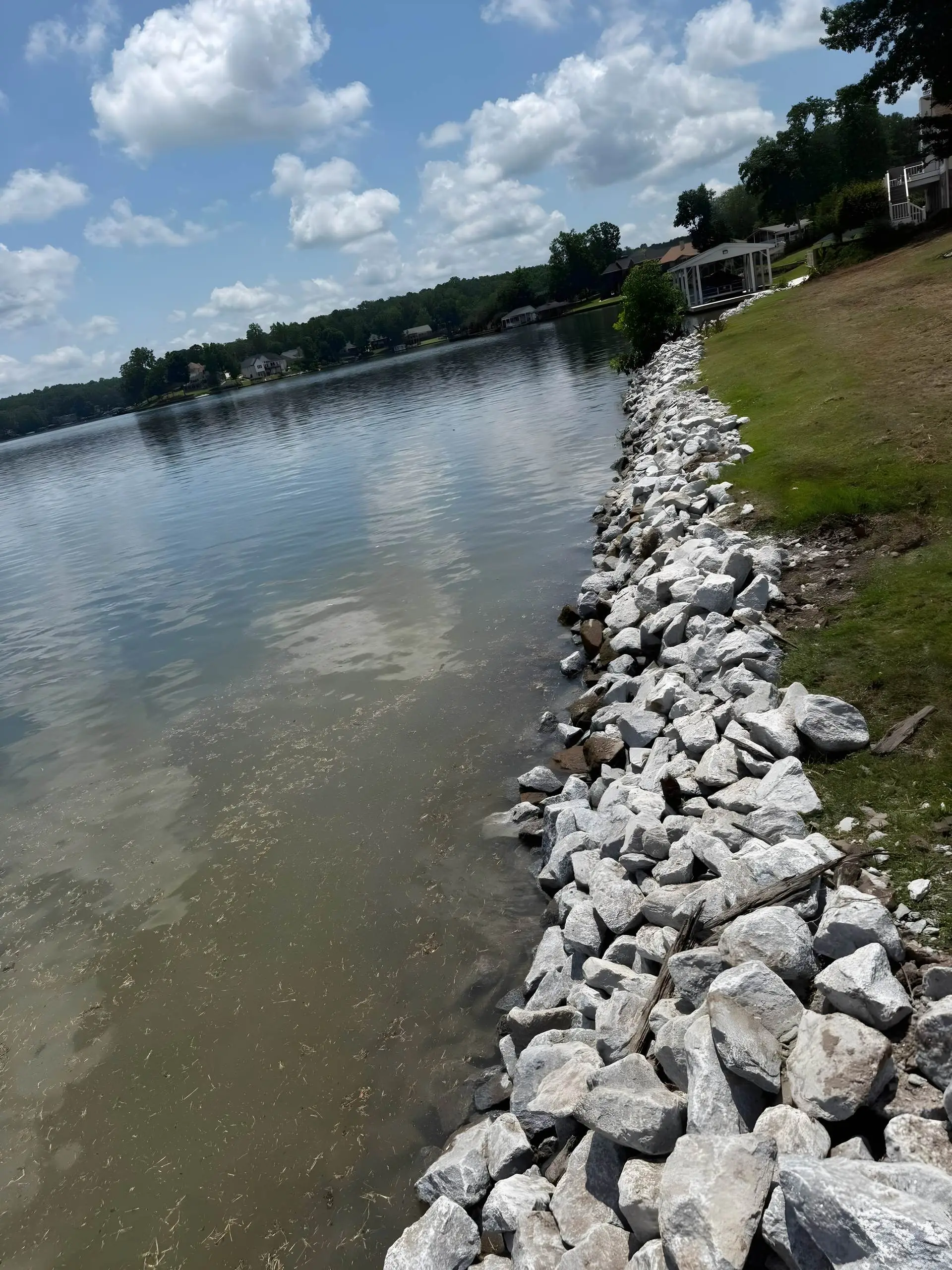
Riprap slows the water down
The Georgia Soil and Water Conservation Commission's Manual for Erosion and Sediment Control in Georgia defines riprap as "a revetment of loose rock or similar material installed on a cut or fill slope or a channel side slope to protect the slope from erosion." Because the stone is loose and the face is sloped, a wave runs up it and loses energy in the gaps instead of slamming into a flat surface.
The manual is specific about what keeps riprap in place. Its riprap standard calls for geotextile fabric between the stone and the soil and no slopes steeper than 1.5 horizontal to 1 vertical. Its streambank section recommends a final slope of at least 1:2, a more stable 1:3 where possible, and a layer of gravel, small stone or filter cloth under the rock, which it says "helps prevent failure." A slope like that takes room: at 1:2, every foot of bank height reaches two feet back from the toe.
A seawall holds the bank up
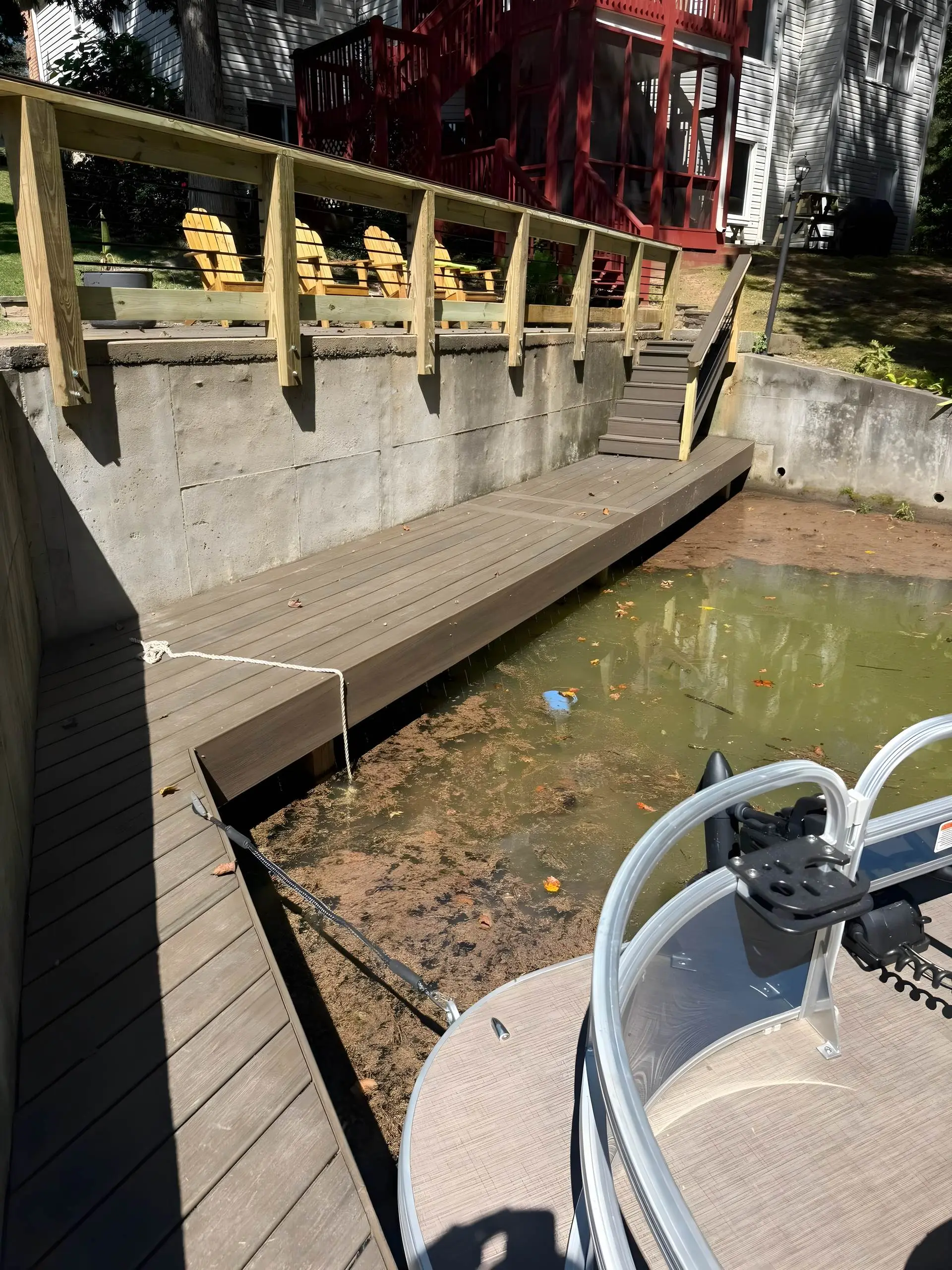
A seawall is a vertical face. Fairfield Plantation's Rules and Regulations define it as "any wall or barrier built, constructed or otherwise placed along the shoreline." The wall itself is only half the job. The wall also has to be tied back into ground that is not going anywhere. Fairfield requires turn-backs at each end of a concrete gravity wall "to anchor the wall to undisturbed soil," and anchors or tiebacks at intervals along a pressure-treated wood wall. The West Point plan's minimum timber wall details point the same direction: a tieback at least every 8 feet, filter cloth over the whole wall, and a weep hole about 2 inches across between each pair of posts, within a foot of the bottom, so water behind the wall can get out.
What red clay changes
The Georgia erosion manual describes soil this way: clay acts as a binder, so clay soils resist erosion, "but, while clays have a tendency to resist erosion, they are easily transported by water once eroded." For a lake owner that means a clay bank resists erosion until it starts to go, and what goes is carried off by the water.
That is why permit offices care about the dirt. Fairfield requires an erosion and sediment control plan with every seawall application, because work that exposes disturbed soil "to precipitation or wave action" can send sediment into the lake.
Tradeoffs
Riprap
- Handles waves. The state manual's riprap guidance is built around protecting the bank "from wave and current action." The West Point plan adds that riprap "provides additional aquatic habitat."
- Needs room. The sloped footprint reaches farther onto the lot and into the shallows than a vertical wall does.
- Needs the right stone and fabric. The manual ties the life of riprap to the slope, the rock size and the filter layer under it. Fairfield sets a floor of 10 pound stone for repairs and toe protection.
Seawall
- Straight edge. A vertical face is what a slip, steps or a swim platform want to sit against. Fairfield measures dock reach from the face of the seawall, or from the natural shoreline on a Lake Ashley or Lake Scarlett lot with no existing seawall.
- Small footprint. It takes less width than a sloped bank of stone.
- Reflects waves. The state manual says bulkheads and seawalls "also tend to reflect wave energy rather than dissipate it, usually resulting in erosion problems in front of the 'fix' and elsewhere."
- Depends on its anchors and drainage. Tiebacks, turn-backs, filter cloth and weep holes are the parts the rules spell out, and they are hidden once the wall is backfilled.
The federal permit text speaks to the choice in general terms. It encourages soft approaches such as plantings "at sites where those methods are likely to be effective," where shorelines are subject to moderate to low erosive forces, and says hard approaches such as seawalls, bulkheads, revetments and riprap "may be necessary at sites where shorelines and banks are subject to strong erosive forces." Among the factors it lists are bank height and condition, wave and current energy, fetch, nearshore depth and sediment type.
One caution on the state manual: its streambank practice ranks plant-based methods first, lists rock riprap among "discouraged practices" (while giving design rules for it), and says bulkheads and seawalls "are not encouraged and generally are not approved." That is general erosion-control guidance. On the lakes below, the shoreline owner's rules decide your lot.
What each lake asks for
West Point Lake
The Corps owns the shoreline, and its Shoreline Management Plan (updated and in effect since October 1, 2025, per the Corps' news release) treats shoreline protection as a limited, local approval. The plan says "riprap is the preferred type of erosion control" and "concrete block walls are not allowed." Plans showing dimensions and materials must be approved before construction. The protection area "must be kept to the minimum necessary to protect and secure" the floating dock's walkway and anchor system, and anything beyond the nationwide permit limits needs a Section 404 permit.
If a wall is approved, the plan's Exhibit III sets minimums: wood walls must use treated material, a minimum height of 637 feet, posts at least 6 by 6 inches and no more than 8 feet apart, toe protection of at least one third of the wall height, filter cloth, weep holes and ties. Our West Point Lake dock page covers the dock side.
Fairfield Plantation
Fairfield makes the seawall a condition of building on Lake Tara. The Rules and Regulations require an approved seawall before or at the same time as the house on every Lake Tara lot, and say seawalls are not required on Lake Ashley or Lake Scarlett. A seawall is a revocable license from the association. Approved types are plain riprap stone, grouted riprap stone, a concrete gravity wall, or pressure-treated wood with concrete footings. Railroad ties, metal and plastic are prohibited, and bags of concrete, plastic or rubber sheets and silt fence fabric may not be used to protect the toe. The application needs a certified survey, a materials list and the erosion and sediment control plan, and an undeveloped lot cannot get a seawall unless its vegetation does not give adequate erosion control.
The owner maintains the wall. If the association decides it is in disrepair, the owner has 30 days to submit an application or preliminary plan, and the association may revoke the license, fine the owner or repair or remove the wall at the owner's expense. More on the neighborhood is on our Fairfield Plantation page.
Lake Carroll
Lake Carroll is a city reservoir. The Carrollton code (Section 70-58) says the shoreline "shall not be altered or changed in any manner whatsoever without written consent and a permit granted by the building official." The sections we reviewed do not say whether that means a wall or stone, so ask the building official before you buy materials. Our Lake Carroll page has the rest of the code.
Other lakes and ponds
Neighborhood lakes and private ponds set their own rules, and many want written approval before any shoreline work. Get the rules and the approval first, then choose the method.
State and federal limits
Two rules apply on top of whatever the lake owner says.
- Georgia's 25-foot buffer. Georgia EPD's buffer guidance, quoting the Erosion and Sedimentation Act, describes "an established 25-foot buffer along banks of all State waters," measured from the point where vegetation has been wrested by normal flow or wave action. Only the EPD Director can allow a variance. Whether a particular lake or pond counts as state waters is a question for the permit office, and it is worth asking before anyone clears the bank.
- Nationwide Permit 13. The Corps' 2026 nationwide permits, effective March 15, 2026 and expiring March 15, 2031, cover bank stabilization such as "vegetative stabilization, bioengineering, sills, rip rap, revetment, gabion baskets, stream barbs, and bulkheads." The activity can be no more than 500 feet along the bank unless the district engineer waives that, no more than an average of one cubic yard of fill per running foot below the ordinary high water mark, and no more material than the minimum needed for erosion protection. Above 500 feet, or past the cubic yard average, the owner must notify the Corps before starting. It also requires the work to be "properly maintained," which may mean repairs after severe storms.
Whether a small private pond is a federal water at all is a separate determination we do not try to settle here.
Side by side
| Factor | Riprap | Seawall |
|---|---|---|
| How it works | Sloped stone absorbs wave energy | Vertical face holds the soil back |
| What keeps it in place | Slope, stone size, filter fabric, a firm toe | Tiebacks or turn-backs, filter cloth, weep holes |
| Waves | Designed to dissipate them | Tends to reflect them, per the state manual |
| Footprint | Wider, because of the slope | Narrower |
| West Point Lake | The preferred type | Wood walls must use treated material; concrete block walls are not allowed |
| Fairfield Plantation | Approved, plain or grouted | Required on Lake Tara lots |
| Lake Carroll | Permit for any shoreline change | Permit for any shoreline change |
When to call a pro
Call before you buy stone or lumber. Stone or a wall depends on who owns the shoreline, how much wave energy reaches your lot and what has to sit against the edge, and approvals take time. If you already have a wall and wonder whether it is failing, read our seawall repair guide. If you are ready for the build or a repair, our seawall and riprap page covers what we do and where. If a dock is in your plans too, read the floating vs fixed dock guide, because West Point ties shoreline protection to the dock's walkway and anchor system.
Questions people ask
Is riprap or a seawall better for a lake bank?
Neither wins everywhere. Riprap is built to dissipate waves and a wall tends to reflect them, but a wall gives a straight edge and a smaller footprint. Wave energy, bank height, soil and the lake's rules decide.
Can I build a concrete block wall on West Point Lake?
No. The Corps plan says concrete block walls are not allowed, and prefers riprap. Wood walls must use treated material, and approved walls must meet the plan's Exhibit III minimums.
Do I have to build a seawall at Fairfield Plantation?
On Lake Tara, yes: an approved seawall is required before or with the house. It is not required on Lake Ashley or Lake Scarlett. Plain or grouted riprap is an approved type.
Do I need a permit to stabilize my bank on Lake Carroll?
The Carrollton code says the shoreline cannot be altered in any manner without written consent and a permit from the building official. Ask that office before you start.
Sources
- U.S. Army Corps of Engineers, Mobile District, West Point Lake Shoreline Management Plan (cover date September 9, 2024): Section 9 (shoreline protection work), Section 14e (bank stabilization), Exhibit III (shoreline erosion control and retaining wall specifications, pages 41 to 42).
- U.S. Army Corps of Engineers, Mobile District, West Point Project implements updated Shoreline Management Plan, news release 25-023, September 29, 2025.
- Fairfield Plantation Property Owners Association, Rules and Regulations for Property Owners (revised February 16, 2026): definitions, Sections 3.3.4.6, 3.5.1.6 and 5.1 (seawall specifications).
- City of Carrollton, Code of Ordinances Section 70-58, Lake Carroll.
- Georgia Soil and Water Conservation Commission, Manual for Erosion and Sediment Control in Georgia, 2016 edition: Chapter 2 (soils), Chapter 6 practice Sb (streambank stabilization, pages 6-59 to 6-60) and Appendix C (riprap).
- Georgia Environmental Protection Division, Buffer Mitigation Guidance (May 2022).
- U.S. Army Corps of Engineers, Reissuance and Modification of Nationwide Permits, Federal Register, 91 FR 768 (January 8, 2026): Nationwide Permit 13, Bank Stabilization, and its Note 2.
Rules change and each lake has its own. Confirm current requirements with the permit office before you build.