Shoreline guide
Seawall repair in west Georgia: signs of failure, repair or rebuild, and how long a seawall lasts
A failing seawall usually shows itself behind the wall first: holes or dips in the ground, new leaning or bowing, cracks that let soil out, or rusted, missing and rotted parts. Whether to repair or rebuild is an engineering call, and at Fairfield Plantation the rules make part of it for you. Published lifespans run from 10 to 40 years, but they come from coastal sources, not Georgia lakes. Before any repair, ask whoever owns the shoreline whether it needs approval.
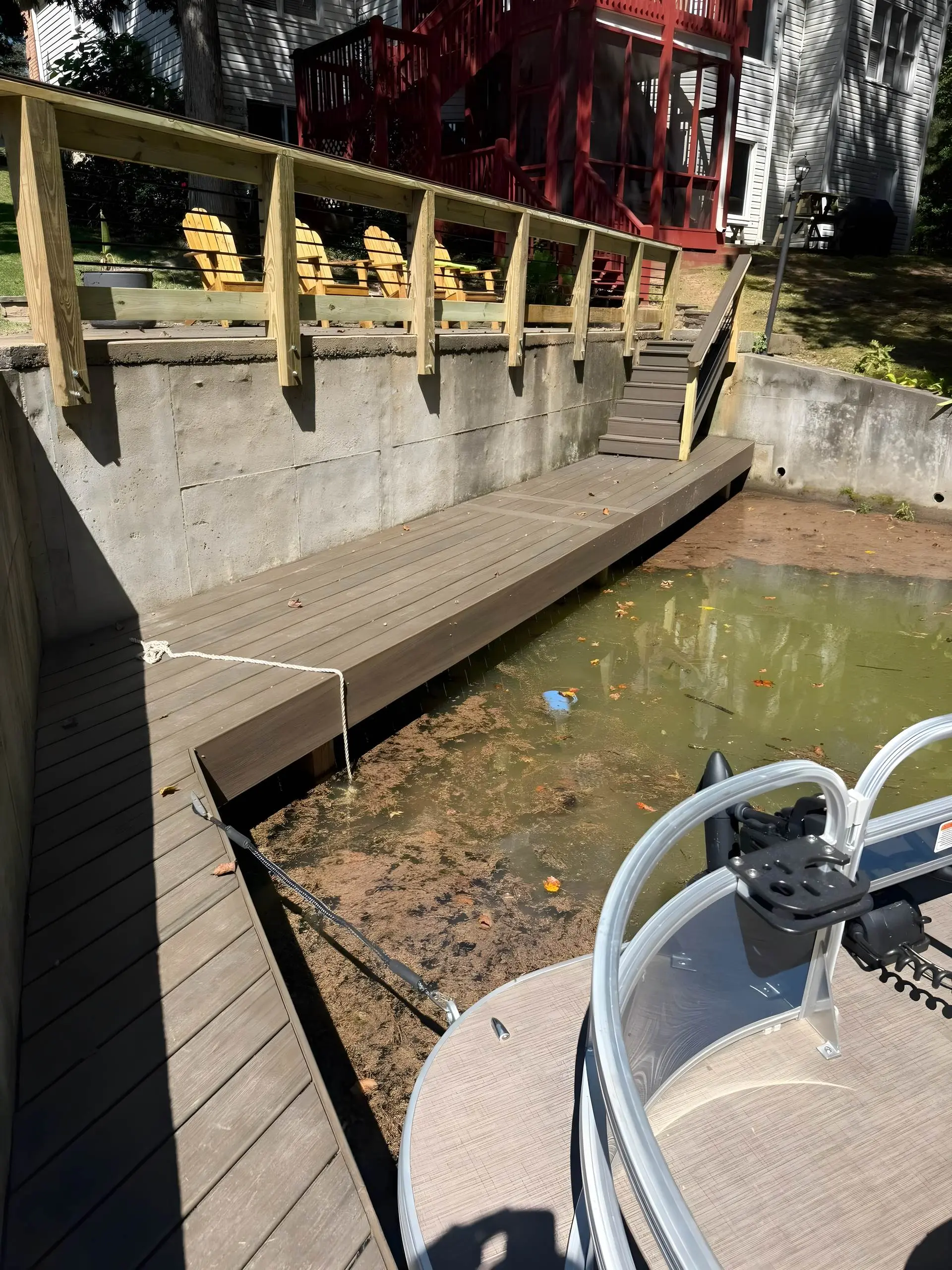
What a failing seawall looks like
The wall is the part you can see. The soil behind it is the part it holds, and that is where trouble starts. North Carolina Sea Grant, writing about coastal bulkheads, tells owners to inspect "seasonally, as well as before and after storms" and to look for three things:
- Divots or holes in the ground near the wall, "which can indicate that failure is occurring below ground."
- Leaning, bowing or wobbles that are new. It suggests a construction level, or the level on a phone, to keep an eye on changes.
- Damaged parts: severe rusting, missing pieces or rotting boards.
A North Carolina coastal handbook for property owners explains why cracks matter. It says "Cracks and holes in the bulkhead will allow soil to escape, weakening the bulkhead's support and leading to possible collapse," and it recommends periodic inspections. It adds that wood is the hardest material to repair.
Both sources are about coastal shores, not Georgia lakes. Read them as a watch list, not a diagnosis.
Why walls fail
The Army Corps of Engineers' Coastal Engineering Manual lists the typical damage modes for seawalls and bulkheads: toe scour leading to undermining, overtopping and flanking, a rotational slide below and behind the wall, and corrosion of any steel reinforcement. In plain terms:
- Scour at the base. For a wall that gets its support from being driven into the ground, the manual says toe scour "results in a loss of embedment length and could threaten the stability" of the wall.
- Lost backfill. The manual says a bulkhead's strength against waves comes almost entirely from the fill behind it. For timber walls it names water seeping through below the filter cloth and carrying sand along as "a common damage mechanism."
- Water pressure. Drainage through the wall is "important to relieve pore pressure from excessive rainfall or overtopping," and drilling weep holes in the face is one way to provide it.
- Corroded connectors. On anchored walls, the manual says corrosion protection at the connectors is "particularly important to prevent failures."
On a lake, boat wakes are one source of waves. Fairfield Plantation's Lakes and Watercraft Rules, in the section on excessive wake, list, among the reasons the board may call a no-wake policy, "the water level in Lake Tara dropping low enough that wakes will cause damage to lake walls." We found no study tying wakes to wall failure on a Georgia lake, so that is as specific as the sources get.
Repair or rebuild: what decides it
We found no university or agency rule of thumb for when a wall is past repair, and we will not invent one. What the sources do say:
- Do not push the wall out. Massachusetts Coastal Zone Management says that when repairing or replacing a wall, "the structure should not be extended farther seaward," and that when erosion is occurring behind a wall it should be pulled back, because leaving it in place and using fill to reclaim land "will likely continue the cycle of erosion." New York's Department of Environmental Conservation says a replacement should ideally go behind the old wall, not 18 to 24 inches further into the water, and warns that unmaintained walls can fail from "inadequate toe protection, subsidence of backfill materials" and poor drainage.
- A rock apron in front is not a permanent fix. Massachusetts notes that small rock revetments are often placed in front of undermined walls, but "As erosion continues, however, the small revetment may also be undermined."
- A slope may be the better rebuild. The same source says that when a wall needs significant repair or reconstruction, replacing it with a sloping rock revetment that does not extend farther out "should be considered." Our seawall vs riprap guide covers how the two compare and what each lake allows.
- The structural call belongs to an engineer. Massachusetts says a coastal engineer should be consulted for site-specific advice.
The Corps manual names two things that keep backfill in, return walls at the ends and filter fabric that lets water through but not fines, and separately calls for drainage such as weep holes to relieve water pressure. If soil is leaving your yard, ask the engineer which of those has failed.
How long a seawall lasts
There is no honest single number. North Carolina Sea Grant puts the life expectancy of a bulkhead at about 25 years, depending on its composition, its location and its maintenance, and says bulkheads "become progressively weaker over time, especially in moderate and high-energy areas."
The North Carolina handbook gives a range: the usual lifespan "varies between 10 and 40 years," with wood at the lower end, concrete in the middle and vinyl or fiberglass at the upper end, and an average of 30 years "with proper construction and maintenance." For riprap it says installations "can last for several decades, although storm events may shorten the lifespan," and that stones settle and readjust with storms and waves and occasionally need replacing.
The two sources differ a little, and both are about estuary shores. We found no published lifespan for a Georgia lake and no credible figure for steel, so treat these as a planning range, not a promise.
Rules for repairs, lake by lake
West Point Lake
The Corps' Shoreline Management Plan treats shoreline protection as limited work that the Operations Manager may approve. Plans for retaining walls and riprap, showing dimensions and construction materials, "must be submitted and approved prior to construction." Concrete block walls are not allowed, wood walls must use treated material, and the protected area is limited to what is needed to protect and secure the dock walkway and anchor system.
We found no separate repair provision for seawalls in the plan. Its minor and major repair definitions are written for permitted floating facilities, so we do not apply them to walls. Call the park office before you order anything, especially if the repair would change the wall's length, height or material. See the West Point Lake page.
Fairfield Plantation
The Rules and Regulations require an application, approved by the Property Compliance Committee (the Rules and Regulations call it the Property Control Committee), "prior to the construction, replacement, repair, modification, or removal of a seawall." Section 5.1.6 adds three repair rules:
- Repairs use material matching the existing wall in color, shape, size and composition.
- On a wall built of materials that are no longer approved, up to 50 percent of its value or surface area may be repaired with like material. Beyond that, the owner applies to replace the wall, and the owner has 30 days to apply once the committee gives notice.
- Riprap walls are repaired with stones of at least 10 pounds. If a riprap wall is removed and replaced, the new one must meet the specifications for a new riprap wall.
Our Fairfield Plantation page covers the neighborhood.
Lake Carroll
Lake Carroll is run by the City of Carrollton. Section 70-58 says the shoreline "shall not be altered or changed in any manner whatsoever without written consent and a permit granted by the building official at city hall." No source we found says whether that covers a repair, so ask the building official before work starts. See the Lake Carroll page.
Private ponds, the state buffer and the Corps
Georgia EPD's 2007 shoreline stabilization guidance says maintenance and repair of existing structures "which result in minor soil erosion may qualify as a minor land disturbing activity" that does not need a buffer variance. It also says building a stabilization project inside the buffer without a variance, other than minor work, violates state law. Work outside the buffer is not subject to variances "but may be subject to other permits." It is 2007 guidance, so confirm it with EPD. Whether your pond counts as state waters is a question for the permit office.
At the federal level, the Corps' 2026 nationwide permits have a maintenance permit, NWP 3, for repair, rehabilitation or replacement of a "previously authorized, currently serviceable structure." The Corps defines previously authorized as a structure authorized by an individual or general permit or by regulation, and says an owner does not need to produce a copy of the old approval to qualify. The same notice says NWP 3 does not cover maintenance of a structure that did not need a permit when it was built. NWP 13, bank stabilization, says the work "must be properly maintained," which may mean repairs after severe storms, and authorizes those repairs "if they require authorization." Whether a given repair needs Corps authorization at all, and which permit fits, is the Corps' call.
What to do this week
- Walk the wall and the yard behind it. Look for the holes, leaning and damaged parts above.
- Take photos from several angles, as North Carolina Sea Grant advises, and note the date and water level. Repeat after the next big storm. A level held against the wall shows new lean.
- Find out who owns the shoreline and call that office, the park office, the association or the building official, before anyone buys materials.
If you want a second set of eyes, describe what you see and name the lake in our quote form. Ambrose may ask for your photos when he replies. Our seawall page has the details.
Questions people ask
How long does a seawall last?
Sources give about 25 to 30 years on average, within a range of 10 to 40, with wood at the short end. Those are coastal figures; we found none for Georgia lakes.
Can a failing seawall be repaired, or does it have to be rebuilt?
It depends on what failed, and an engineer should make the call. Sources warn against pushing a wall further out or relying on a small rock apron. At Fairfield, a wall built of materials no longer approved can be repaired with like material only up to half its value or surface area; beyond that the owner applies to replace it.
Do I need a permit to repair a seawall?
Usually some approval applies. West Point wall plans are approved before construction, and we found no separate repair rule. Fairfield repairs need an application. On Lake Carroll, ask the building official.
Sources
- North Carolina Sea Grant, Bulkhead Challenges and Tips (April 24, 2026): inspection, signs to watch and life expectancy.
- N.C. Division of Coastal Management and N.C. National Estuarine Research Reserve, Weighing Your Options: How to Protect Your Property from Shoreline Erosion (2011): bulkhead maintenance and longevity, riprap longevity.
- U.S. Army Corps of Engineers, Coastal Engineering Manual, EM 1110-2-1100, Part V, Chapter 3 (June 1, 2006): damage modes, backfill and drainage.
- New York State Department of Environmental Conservation, AHP-01, Shoreline Protection: failure causes and replacement placement.
- Massachusetts Office of Coastal Zone Management, StormSmart Properties Fact Sheet 7: Repair and Reconstruction of Seawalls and Revetments.
- U.S. Army Corps of Engineers, Mobile District, West Point Lake Shoreline Management Plan (cover date September 9, 2024): Section 9 (shoreline protection work), Section 14e (bank stabilization), Section 16 and Exhibit III.
- Fairfield Plantation Property Owners Association, Rules and Regulations for Property Owners (revised February 16, 2026): Sections 5.1.5 and 5.1.6; and the Lakes and Watercraft Rules (revised July 21, 2025): Section 9.7.1.
- City of Carrollton, Code of Ordinances Section 70-58, Lake Carroll.
- Georgia Environmental Protection Division, Streambank and Shoreline Stabilization Guidance (July 2007).
- U.S. Army Corps of Engineers, Reissuance and Modification of Nationwide Permits, 91 FR 768 (January 8, 2026): NWP 3 and NWP 13.
Rules change and each lake has its own. Confirm current requirements with the permit office before you repair or rebuild.