Dock guide
Boat lift options on west Georgia lakes
The lift that fits depends on three things: how much your lake rises and falls, how deep and firm the bottom is, and what your lake allows. Vertical cable lifts suit firm, shallow, steady water. Hydraulic cantilever lifts handle soft bottoms. Floating lifts follow the water. Then check the rules: at Fairfield a boat lift must sit inside a covered slip, and a West Point floating dock at maximum size has to keep every lift inside its slips.
The main lift types
Boat lifts come in four families. They differ in how they raise the boat, where they stand and how they cope when the lake level moves. The makers' own descriptions below are the source for the specs, and we say so each time, because a manufacturer's page is a sales page as well as a data sheet.
| Type | How it lifts | Where it tends to fit |
|---|---|---|
| Vertical (cable) | Cables, pulleys and a winch raise a rack | Firm bottom, steady water, an existing fixed dock |
| Hydraulic cantilever | Hydraulic cylinders swing the frame up, no cables | Soft or mixed bottoms, shallow to moderate depth |
| Floating | Air pushed into tanks forces water out | Deep or changing water, floating docks |
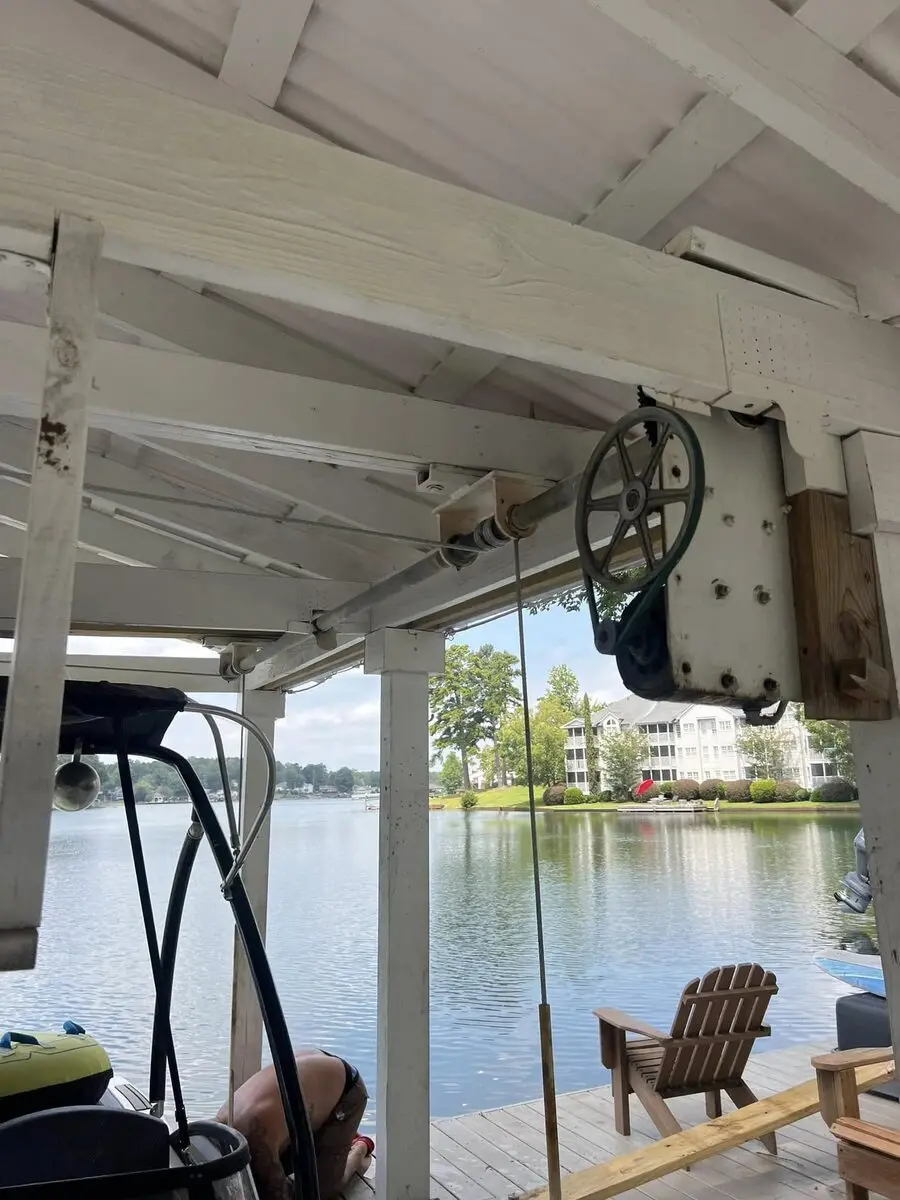
| Overhead hoist | Cable hoist fixed to the boathouse roof | Covered slips built to carry it |
Vertical lifts
A vertical lift uses cables, pulleys and an electric or manual winch to raise the boat, and its frame is fixed to the lakebed, the dock or pilings, according to HydroHoist, which makes floating lifts and describes both kinds in its comparison of floating and vertical lifts. It says vertical lifts work best in shallower lakes with firm, level bottoms and water that stays fairly steady through the season, and that they can be added to an existing fixed dock. Because the lift stands on the bottom, the travel it has depends on its design and on the water depth. If the water falls or rises outside that range, HydroHoist says, the legs or cables may need manual adjustment.
ShoreMaster's vertical lifts are a typical example: welded aluminum frames, 66 inches of rack travel and an 84 inch winch post that the maker says handle fluctuating water. That range is a real number you can hold against your lake: if the pool can drop further than a lift's travel, the lift will not do the job.
Cantilever and hydraulic lifts
Hydraulic cantilever lifts raise the boat with cylinders instead of cables. ShoreMaster says its hydraulic lifts suit water from 3 to 7 feet deep (16 inches plus the boat's draft at the minimum), work on soft, firm or semi-firm bottoms, lay flat in shallow water, and come in 48 or 60 inch travel and 6,000 to 12,500 pound ratings. It also says the sealed system means no cables or pulleys to adjust.
ShoreStation, another maker, describes dock-mounted lifts with a hydraulic design that uses DC power, with a solar or AC-charged battery unit, so no AC circuit has to run out on the dock. It also describes "deck over" and "under deck" mountings that keep the lift components low or out of sight. Those mount to the dock itself, which matters for the next section on rules.
Floating lifts
A floating lift uses flotation tanks. HydroHoist explains that a blower pumps air in to push water out and raise the boat, and releasing air lets the platform sink so the boat floats off. Because it moves with the water, HydroHoist calls it the best choice for fluctuating water, deep water, and bottoms of rock or thick mud where legs are impractical. It adds that floating lifts mostly pair with floating docks, and that capacity can be scaled by adding tanks (the maker lists boats up to 32,000 pounds and more).
The upkeep is different from a cable lift. HydroHoist says to check air hoses for leaks and keep the tanks clear of heavy marine growth. ShoreMaster's floating lift page adds that most floating lifts need anchoring suited to the depth, the bottom and the wind and waves.
Jet-ski lifts
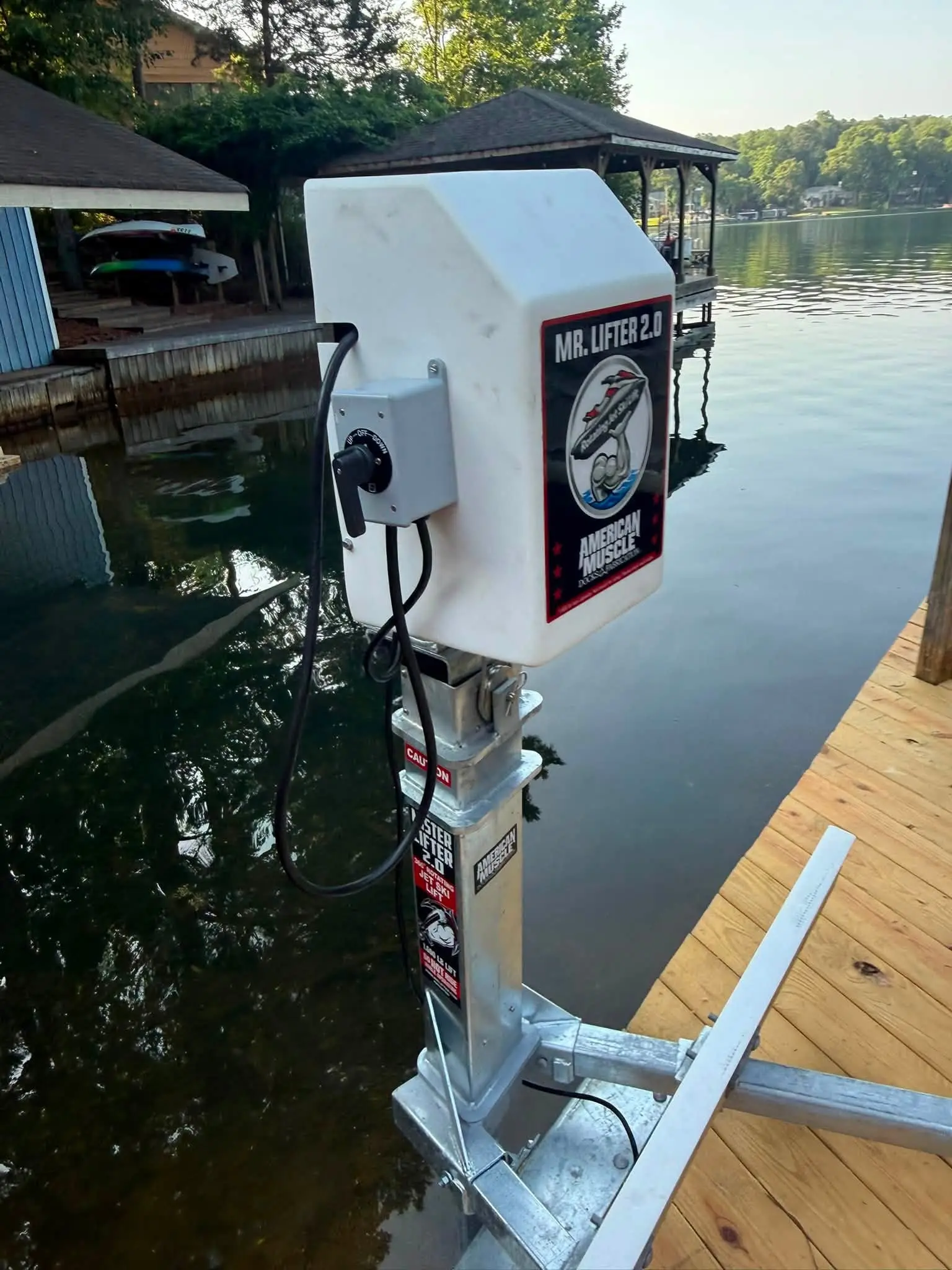
Personal watercraft lifts are their own category because they are lighter and sit beside or in a slip. ShoreMaster's PWC lifts come in vertical and cantilever designs, with 64 inch rack travel on the vertical type and optional motors. ShoreStation's freestanding vertical PWC lift is listed for water up to 5 feet 6 inches deep and a 1,500 pound capacity.
Jet-ski lifts get their own line in lake rules. Fairfield caps them (see below), and West Point counts them in the facility's measurements.
Capacity basics
Match the lift to the boat before you match it to the dock. ShoreMaster's lift models page offers a calculator that starts from the boat's dry weight and says the result is "a starting point" for a local dealer to confirm against your model, water depth and shoreline. A few points follow from that.
- Dry weight is not loaded weight. The boat you lift also carries fuel, gear, and on wake boats and pontoons possibly ballast water or extra equipment. Compare the lift's rating with the boat as you actually store it.
- Ratings come in steps. ShoreMaster's hydraulic lifts, for example, run from 6,000 to 12,500 pounds, so a boat near a limit usually means the next size up.
- Hull shape matters. Makers sell different bunks and rails for pontoons, tritoons and V-hulls, and ShoreMaster notes some configurations apply only to its 6,000 pound models. Say what you own when you ask for a lift.
- Depth and travel have to cover your lake. A lift's travel, and the water it needs under the boat, must work at your lowest and highest pool.
How lifts fit dock rules
A lift is rarely a separate purchase from the dock. Here is what the documents say for each place.
West Point Lake
The Shoreline Management Plan measures a floating facility to include roof overhangs and any appurtenant personal watercraft lifts. No new floating facility may exceed 32 feet on one side. Its example at maximum size (1,024 square feet, 100 feet long) states that "no additional items may be added to the exterior of the floating facility, such as PWC lifts and/or boat lifts," and that any watercraft docking device "must be installed within the slips of the floating facility." So if you want the biggest dock allowed, the lift goes inside a slip. Below the maximum, a PWC lift still adds to the measured area. Any new electrical service on a floating facility must be certified by a state licensed electrician under the plan's electrical requirements. Because the plan covers floating facilities, ask the Project Office how it treats a lift that stands on the lake bottom before you design one. More on the lake is on our West Point Lake dock page.
Fairfield Plantation
The neighborhood's Rules and Regulations are specific:
- Boat lifts "shall only be constructed or installed within a Covered Boat Slip." The rules define a boat lift as either an overhead cable hoist affixed to the roof of the covered dock, or a metal structure installed in the lake and affixed to the inside of the slip.
- Any boat lift in any lake must be a non-corrosive metal such as stainless steel or aluminum, and no canopy, tarp or sheeting may be hung from it.
- Only metal lifts designed and used for personal watercraft, with a maximum capacity of 1,000 pounds, may be permitted next to a dock or slip, and they cannot encroach on the 10 foot extended property sideline.
The 1,000 pound cap is written as the lift's maximum capacity. Several PWC lifts on the market are rated higher (one ShoreStation model above is listed at 1,500 pounds), so compare the rating to the cap before you order anything. The permit application also asks whether a boat lift is included in the covered slip. Our Fairfield Plantation page covers the neighborhood.
Lake Carroll
Carrollton's Section 70-58 limits private docks, piers and related structures to 20 feet from the shoreline and requires a permit from the building official. The sections we reviewed do not single out lifts, so ask the building official whether yours counts against that reach. Our Lake Carroll page has the rest.
Power and upkeep
Cable lifts need their cables, pulleys and winch inspected. Hydraulic lifts need fluid levels, hoses and fittings checked, according to ShoreMaster. Floating lifts need air hoses, blowers and clean tanks, according to HydroHoist. For any powered lift, power is a decision to make with the dock design: a DC battery system such as the ShoreStation one above avoids an AC circuit, and an AC feed to a floating dock on West Point has to be certified by a licensed electrician. Ask a licensed electrician about anything wired to the water.
We build and repair docks and install boat lifts and jet-ski lifts as part of dock work. If you are weighing a lift against a new dock, read our guide to floating versus fixed docks first, because the dock type narrows the lift choices.
Questions people ask
Which boat lift is best for a lake that rises and falls?
Floating lifts move with the water, which is why HydroHoist recommends them for fluctuating levels. A vertical lift works if its travel (66 inches on one ShoreMaster model) covers your lake's swing.
Can I put a boat lift on my dock at Fairfield Plantation?
Only inside a covered boat slip, made of non-corrosive metal, with no canopy or tarp hung from it. Jet-ski lifts adjacent to a dock are capped at 1,000 pounds of capacity.
Do lifts count toward dock size on West Point Lake?
The plan includes appurtenant jet-ski lifts in a floating facility's measurements. At the maximum size, no lifts can be added outside the slips.
How do I size a lift for my boat?
Start from the boat's dry weight, add what you carry, and let a dealer confirm. ShoreMaster describes its calculator result as a starting point.
Is a floating lift easier to maintain than a cable lift?
HydroHoist says yes, since there are no cables and pulleys to fray, but you still scrape marine growth off the tanks and watch the blowers and air hoses.
Do I need a permit to add a lift to an existing dock?
At Fairfield, yes: the application form lists installing a boat lift or a jet-ski lift as items. For West Point and Lake Carroll, ask the permit office before you order, because both set limits that a lift can affect.
Sources
- U.S. Army Corps of Engineers, Mobile District, West Point Lake Shoreline Management Plan: Exhibit VII (floating facility measurements), the electrical service requirements and Exhibit XIV.
- Fairfield Plantation Property Owners Association, Rules and Regulations for Property Owners (revised February 16, 2026): definitions of Boat Lift and Covered Boat Slip, Section 5.2.2 items 15 and 16.
- City of Carrollton, Code of Ordinances Section 70-58.
- HydroHoist, Floating vs. Vertical Boat Lifts: When Each System Wins. A manufacturer's statements about its own product category.
- ShoreMaster, lift models, with pages for vertical, hydraulic, floating and PWC lifts. Manufacturer specs, quoted as the maker states them.
- ShoreStation, freestanding and permanent boat lifts. Manufacturer specs.
Rules change and each lake has its own. Confirm current requirements with the permit office before you build.