Repair guide
Deck repair or replace: how to tell
Look at the frame, not the boards. If the posts, beams, joists and the ledger at the house are solid, you can replace boards or re-deck the surface and railings. If the frame is rotted, loose at the house or sunk at the footings, new boards only hide the problem, and the deck needs a rebuild. A screwdriver, a flashlight and 30 minutes will tell you which one you have.
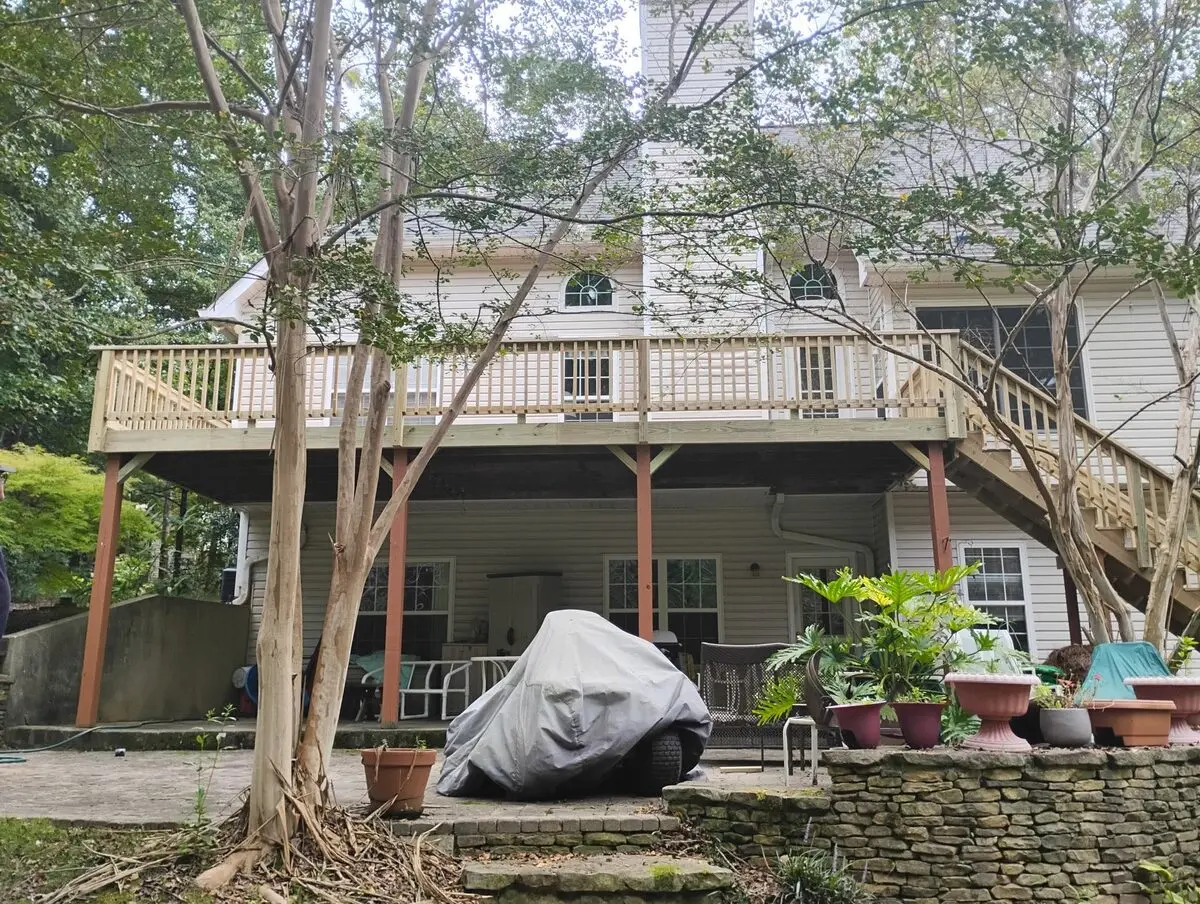
The frame decides
People search for a repair because the boards look bad: gray, cupped, a few soft spots near the stairs. Boards are the cheap, visible layer and the easy one to swap. The deck's safety is in what you cannot see from above: the ledger fastened to the house, the posts and their footings, the beam and the joists. So the question is never "are my boards bad?" It is "is what holds the boards up still sound?"
If it is, repair is almost always the right call. If it is not, nothing you put on top fixes it. Trex, which makes composite decking and has no reason to talk you out of a sale, says on its resurfacing page that you can replace the surface and the railings as long as the foundation and framing are sound, and that you should check joist spacing, the framing's condition and the framing hardware before you start.
Why wood fails, and where
Wood rots because it stays wet. The USDA Forest Products Laboratory's Wood Handbook explains that serious decay needs the wood to hold moisture above the fiber saturation point, which averages about 30 percent. Humid air alone grows mold but does not cause significant decay. Wood kept at 20 percent or less has a reasonable margin of safety, and decay that is already there will not progress if the wood is kept dry.
That tells you where to look. Water collects where it can sit, so rot starts at:
- the top face of joists and beams, under the gaps between boards,
- the ends of joists and the bottoms of posts, where end grain wicks water,
- the ledger at the house, where a missing or failed flashing lets water run behind the board,
- the bases of railing posts, where water follows the fastener in,
- and the stair stringers, where the cut ends sit on the ground or a wet landing.
The Wood Handbook also gives you a way to tell what you are looking at. Brown rot leaves wood darker, with cubical cracking, and it crushes to powder. White rot bleaches the wood and leaves it spongy, but it holds its shape. Termites hollow wood from the inside, so sound-looking wood can have a shell over empty galleries; the handbook says to probe with a pick or knife. It also notes that decay fungi can hollow wood-plastic composites once water gets into cracks, so composite boards are not a guarantee on their own.
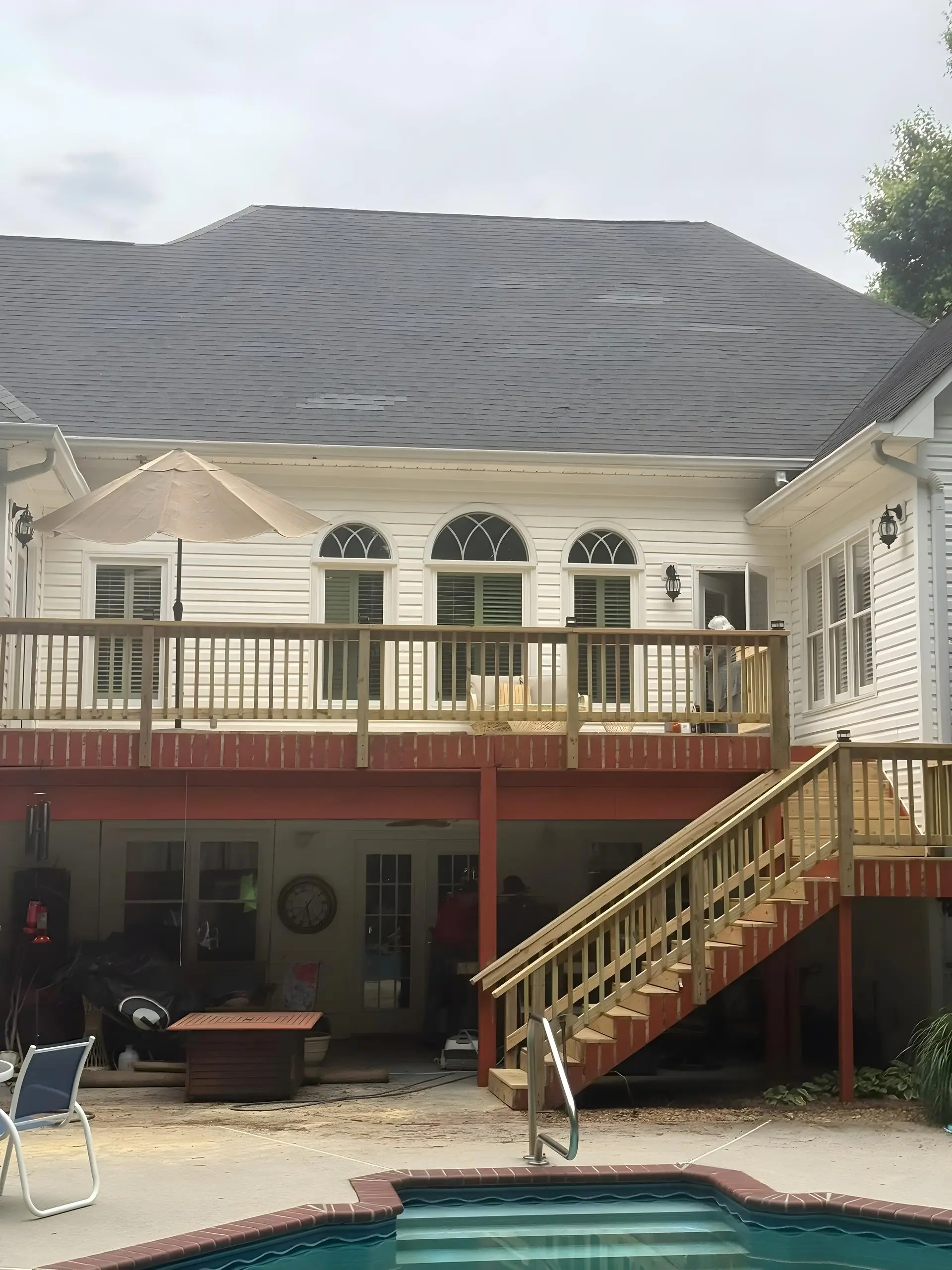
A 30-minute check you can do yourself
You need a flashlight, a flat screwdriver or an awl, and a pair of gloves. Work from the house outward. Stay off any area that moves or sounds hollow, and stop at anything that frightens you.
- The ledger and the house wall. If you can see it from the ground or crawlspace, look for stained siding, a gap between the ledger and the house, and any sign that the board has pulled away or the fasteners have rusted. This is the connection that holds the deck to the house. If the flashing was never installed, the board behind the deck is the one that is rotting.
- The posts and footings. Push on each post at the top. Probe the bottom six inches with the awl. Look for posts that lean, sit in standing water or have no connector at the footing.
- The joists. Probe the top face where the boards cross and the ends where they meet the beam and ledger. Wood that is dark and crushes under the awl is rotted. Wood that resists is probably sound.
- The beam. Check the same way, especially where the joists hang from it and where it sits on the posts.
- The stairs. Probe the stringers where they meet the ground and where they meet the deck. Check that each tread is solidly fixed to a stringer.
- The railing. Shake each post. A post that wobbles is a post that is not fixed to the framing, and rail posts are what keeps a person from falling off the edge.
- Walk it. Bounce gently along the edges and corners. A deck that sways or sags is telling you something.
What you find, and what it means
The table below sorts what you are likely to find into an answer. It is a guide, not a diagnosis.
| What you find | Usual answer | Why |
|---|---|---|
| A few soft, cupped or split boards; framing probes solid | Repair | The decking is the only failed part, and replacing boards is a surface job. |
| Boards worn or gray everywhere, framing solid | Re-deck, or refinish | The frame has life left. New surface and railings on a sound frame is the middle path below. |
| Rot at joist tops or ends in one area | Repair, framing first | Isolated framing can be sistered or replaced. Fix the water source, or it comes back. |
| Rot or hollow wood spread across joists or the beam | Rebuild | You would be replacing most of the frame; at that point you are rebuilding the deck. |
| Ledger pulled away, stained wall, failed flashing | Stop and get it looked at | This is the connection to the house, and the code treats it as a safety item. It may be repairable, but not with boards. |
| Posts rotted at the base, leaning or not on footings | Rebuild, or post replacement | Everything above rests on the posts. A post that cannot be fixed to a good footing is the deck's end. |
| Rail posts loose, rail not up to height or gap size | Repair rails; check the framing | A railing is only as strong as what it is fixed to. See the railing guide for the numbers. |
| Termite galleries under a sound-looking surface | Call a pest professional, then reassess | The wood must be probed, and the colony dealt with, or the repair will be eaten again. |
The middle path: re-deck on a sound frame
A deck with a good frame and tired surface does not have to be replaced. Re-decking strips the old boards, and sometimes the railings, and puts new surface material on the existing framing. Trex's resurfacing page lists what has to be true: sound framing, correct joist spacing for the new material, framing hardware in compliance, and joists shimmed or shaved level before the new boards go on. It also says to get permits first.
Spacing matters more than people expect. Composite boards generally need joists no more than 16 inches on center, and 12 inches for a diagonal pattern, according to Trex's joist guide. A frame built for wood at wider spacing may need joists added before composite goes on top. See our composite vs pressure-treated guide for how the two materials behave in west Georgia.
Single boards are a smaller job still. Trex's guide to replacing a composite deck board adds a detail worth borrowing for any material: old screw holes in the joist should be sealed with sealant or joist tape, so they do not become a path for water.
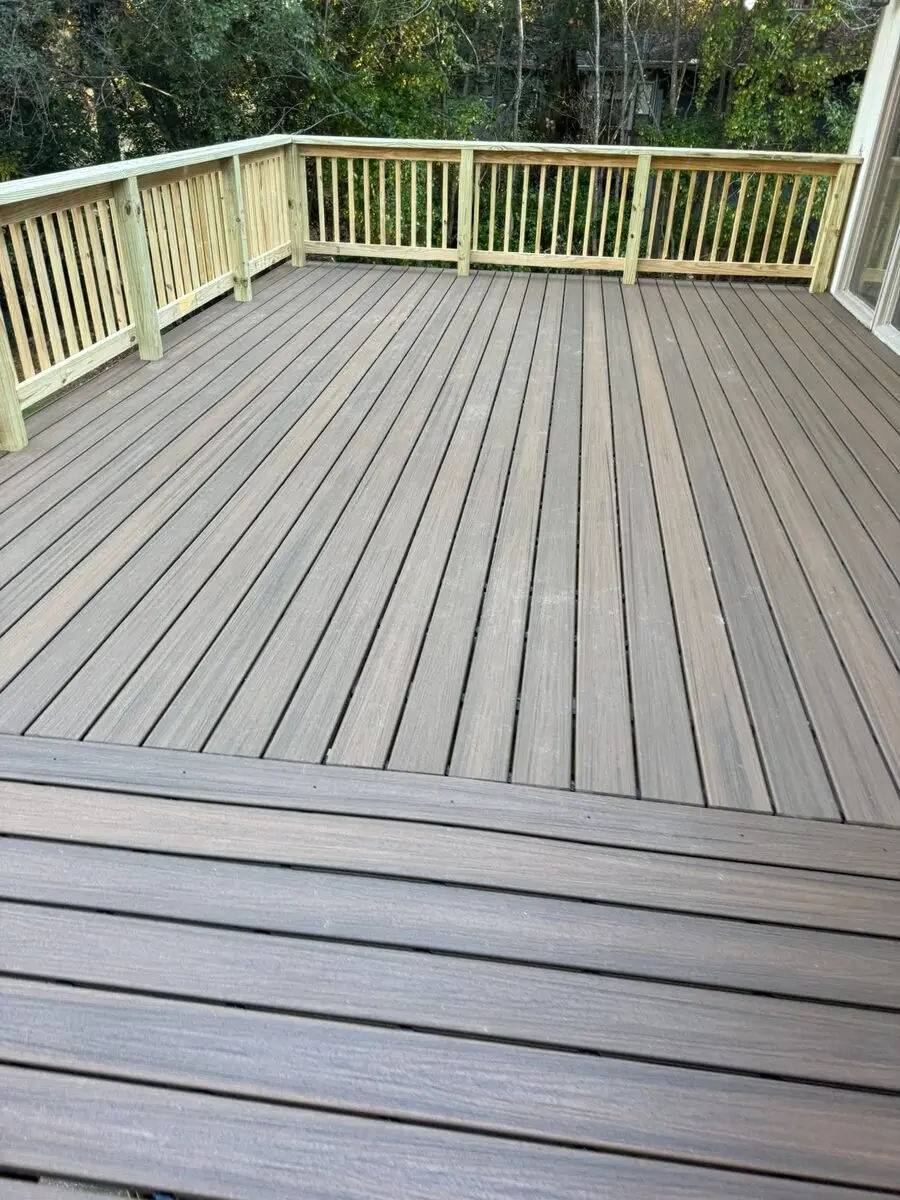
What a rebuild triggers
Repair and rebuild are not just a difference in scope. They are a difference in what the building office expects.
- Permits. Cities and counties differ. Villa Rica says repair, additions and remodeling usually need a permit. Carroll County's code requires a permit to alter or repair, and its list of exempt work does not name decking. At Fairfield Plantation, the community rules exempt replacing or refinishing decking under 50 square feet, but require a permit for damaged decking over 50 square feet and for replacing an existing deck. Our deck repair page has the detail, and the Carroll County permit guide covers who issues what.
- Current code. A new frame is built to the code in force now. Georgia enforces the 2024 International Residential Code with its 2026 amendments, which rewrote the ledger fastening details. Footings, guard height, stair dimensions and ledger flashing all get checked. The railing, stairs and footings guide has the numbers.
What drives the cost
We do not quote from a web page. Here is what moves a repair or replacement up or down, in the order it usually matters:
- Frame condition. Sound frame, new surface: the cost is mostly material and labor on top. A bad frame is the largest swing.
- Size and height. More area, and a deck far above the ground, adds material, posts, bracing and the railing the code requires.
- Surface material. Pressure-treated, cedar, composite and PVC all land in different places, and so does the railing system.
- Access. A deck on a slope or over a pool takes more time than one on flat ground.
- What is hidden. Rot under the boards, a missing flashing, termite damage.
If you want a number, send us your deck's size, height and what you found in the check above, and we will tell you straight whether it is a repair, a re-deck or a rebuild before anyone talks about money.
Questions people ask
Can I just replace the deck boards?
Yes, if the joists under them probe solid. Replacing boards on a rotted frame hides the problem and puts new screws into soft wood. Check the top of the joists first.
How do I know if the deck frame is rotted?
Probe it with an awl or screwdriver. Sound wood resists. Rotted wood gives, crushes or crumbles, and may be dark with cubical cracks or pale and spongy. Look at the joist tops, the joist ends, the bottoms of posts and the ledger at the house.
Can I put new decking over the old frame?
Yes, when the frame is sound, the joist spacing suits the new material and the framing hardware meets code. Joists may need to be shimmed level, and permits come first. Trex's resurfacing guidance lists the same conditions.
Do I need a permit to repair a deck?
It depends on the jurisdiction and the scope. Villa Rica and Carroll County treat repair as permit work in general, and Fairfield Plantation exempts small decking replacement and requires a permit for larger jobs. Call your building office before you start.
Will my homeowner's insurance cover a rotted deck?
That is a question for your policy and your adjuster. We cannot answer it from here, and the answer turns on the wording of your coverage and the cause of the damage.
Sources
- USDA Forest Products Laboratory, Wood Handbook, Chapter 14, Biodeterioration of Wood (FPL-GTR-282, 2021): moisture threshold for decay, brown and white rot, termite galleries and decay in wood-plastic composites.
- Trex, Resurface your deck: conditions for replacing the surface and rails on an existing frame.
- Trex, How to replace a composite deck board: sealing old screw holes.
- Trex, How to install deck joists: maximum joist spacing under composite.
- Georgia Department of Community Affairs, Georgia State Amendments to the International Residential Code (2024 Edition), revised January 1, 2026.
- City of Villa Rica, Building Inspections; Carroll County, Code of Ordinances, Sec. 18-15, permits; Fairfield Plantation, Rules and Regulations (2021 revision, board-approved February 16, 2026).
Rules change and every office reads them its own way. Confirm current requirements with your building office before you start work.